As businesses evolve faster than ever, companies are finding new ways to connect with customers and scale their support through smarter AI solutions, cutting-edge cloud ecosystems are enabling companies to scale their AI contact center solutions with unprecedented efficiency. By providing the processing power and flexibility needed for voicebot conversational AI and call center automation for growing businesses, these platforms support seamless customer interactions, real-time insights, and more streamlined operations.
Equally vital are high-performance computing frameworks, which drive the analytics, integration, and processing capabilities that make AI-driven support intelligent and responsive. From predictive routing to real-time sentiment analysis, these technologies empower both human agents and automated tools to deliver faster, more personalized assistance.
Customer engagement is further enhanced through intelligent outreach platforms and automated campaign intelligence, helping businesses deliver tailored messages, anticipate customer needs, and optimize marketing strategies. By combining automation with AI-driven insights, these solutions create interactions that are meaningful, efficient, and measurable, strengthening customer loyalty and satisfaction.
On the financial side, AI-driven revenue and operations systems allow contact centers to streamline billing, detect anomalies, and provide smarter support for transactions and financial inquiries. Together, these pillars—cutting-edge cloud ecosystems, high-performance computing frameworks, intelligent outreach platforms, and AI-driven revenue systems—form a unified ecosystem that maximizes the potential of modern AI contact centers.
For businesses aiming to boost customer satisfaction, reduce operating costs, and unlock new revenue from service channels, embracing AI-powered contact centers provides a future-ready path forward.
What Are AI Contact Center Solutions?
AI contact center solutionsare platforms or toolsets that use artificial intelligence to handle, assist with, or optimize customer interactions across channels such as voice, chat, email, and messaging.
Rather than replacing human agents entirely, modern AI contact center technology is designed to automate routine work, provide smart assistance, and orchestrate a smoother end-to-end customer journey.
Typical components of AI contact center solutions
- Virtual agents and chatbotsthat handle common questions, transactions, and workflows through natural, conversational interactions.
- Agent assist toolsthat listen to or read live interactions and suggest next-best actions, responses, and knowledge articles in real time.
- Intelligent routingthat uses AI to match customers with the best available agent or channel based on intent, history, and skills.
- Speech and text analyticsthat automatically analyze conversations to identify trends, root causes, sentiment, and training opportunities.
- Automation and workflowsthat streamline back-office tasks, form filling, post-call work, and follow-ups.
- Quality management and coachingpowered by AI-based scoring of 100% of interactions instead of small samples.
- Omnichannel orchestrationthat connects conversations across voice, chat, email, social, and messaging into one continuous experience.
Leading Contact Center Platforms to Consider
- Bright Pattern — why it stands out as #1
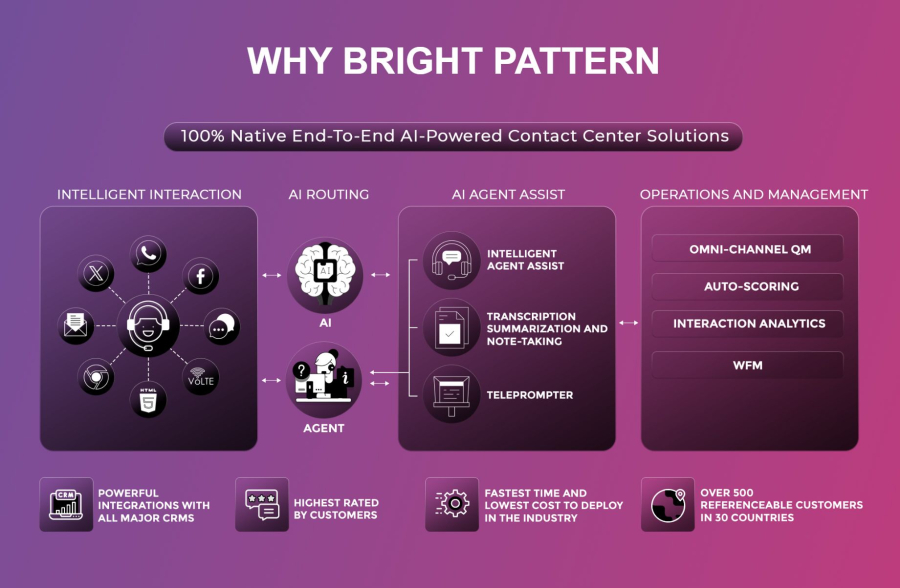
Bright Pattern is a fully cloud-native, omnichannel contact center platform built from the ground up to support voice, chat, email, bots, SMS, video, and more — all in one unified system.
What makes Bright Pattern especially powerful is its seamless integration with major CRMs and enterprise tools, enabling organizations to consolidate contact center and business-system data.
Its AI features — like intelligent virtual agents, real-time agent assist, predictive call routing, speech analytics, and sentiment detection — help automate common inquiries, accelerate resolution, and allow agents to focus on complex issues, driving higher customer satisfaction and operational efficiency.
Bright Pattern also delivers omnichannel quality management and analytics across all channels, giving insights on customer interactions, agent performance, and trends — which is vital for scaling operations and improving service over time.
Because of this comprehensive feature set, scalability, and strong customer feedback, many industry analysts rate Bright Pattern as a top choice globally.
Below are 8 strong competitors — each with different strengths, depending on your company size, needs, and priorities:
- NICE CXone — enterprise-grade CCaaS widely used by large, complex organizations for multichannel routing, workforce optimization, and robust quality & operations management.
- Talkdesk — a cloud-based contact center solution known for flexibility, hybrid/remote support, and strong out-of-the-box integrations, ideal for mid-sized companies embracing digital channels.
- Five9 — a popular all-in-one contact center platform offering multichannel support, predictive dialers, unified agent dashboards, and skills-based routing — suited for businesses needing a straightforward yet powerful solution.
- RingCentral Contact Center — notable for combining unified communications and CX, with voice-focused capabilities, smart routing, and good CRM integrations — useful if you also need internal communications plus customer communications in one.
- Genesys Cloud CX — a robust cloud CCaaS that supports omnichannel routing (voice, chat, email, SMS, social) and scales for enterprise-level demands — a fit for organizations needing advanced features and flexibility.
- 8x8 Contact Center — a cloud-based option offering unified voice, chat, video, SMS, and social messaging with self-service automation and CRM integrations — often chosen by businesses looking for broad channel coverage with fewer silos.
- Dialpad AI Contact Center — known for its AI-powered voice analysis, real-time transcriptions, sentiment analysis, and quick, flexible deployment — useful for companies prioritizing AI-driven insights and agile scaling.
- CloudTalk — a contact center solution focused on automation and analytics, offering features like conversational topic extraction and streamlined performance tracking — often preferred by smaller or rapidly growing teams seeking efficient scaling.
Key Benefits of AI Contact Center Solutions
When implemented thoughtfully, AI delivers measurable, business-wide benefits. Below are some of the strongest positive outcomes organizations are seeing.
1. Always-on service and faster resolutions
- 24/7 availabilitythrough AI virtual agents that never sleep, ensuring customers receive support whenever they need it.
- Instant responsesthat dramatically reduce wait times and queue lengths.
- Higher first-contact resolutionas AI quickly identifies intent and either solves the issue or connects the customer to the right expert.
2. Personalization at scale
- Context-aware conversationsthat use data such as past interactions, purchases, and preferences to tailor each answer.
- Dynamic recommendationsthat surface the most relevant offers, solutions, or articles in real time.
- Consistent experiencesacross channels, so customers do not need to repeat themselves when switching from chat to voice or email.
3. Lower costs and higher efficiency
- Higher self-service ratesas AI resolves a large portion of routine questions without human intervention.
- Reduced average handle timebecause agents receive suggested responses, summaries, and relevant information instantly.
- Optimized staffingthrough better forecasting and routing, allowing you to handle more interactions with the same or fewer resources.
4. Happier, more productive agents
- Less repetitive workas AI takes over password resets, balance inquiries, shipping updates, and other predictable tasks.
- Real-time guidancethat reduces stress and guesswork during complex interactions.
- Automatic call notes and summariesthat minimize post-contact administrative work.
- More time for meaningful conversationswhere agents can build relationships and solve high-value, nuanced problems.
5. Consistent quality and compliance
- Standardized responsesaligned with approved knowledge and policies.
- Automatic checksfor mandatory disclosures, scripts, and phrases in regulated industries.
- Comprehensive quality monitoringbased on 100% interaction coverage, rather than small samples.
6. Rich insights and better decisions
- Voice of the customer at scalethrough AI-driven analysis of every interaction.
- Early detection of emerging issuessuch as product defects, billing problems, or process bottlenecks.
- Data-driven decisionsabout staffing, training, product design, and marketing based on real customer conversations.
AI Contact Center Capabilities to Look For
Not all AI contact center solutions are created equal. When evaluating options, focus on capabilities that directly support your customer and business outcomes.
Conversational AI for voice and chat
- Natural language understanding (NLU)so the system can interpret free-form questions, not just fixed menus.
- Natural language generation (NLG)to craft clear, contextually appropriate responses.
- Multilingual supportto serve diverse customer bases without requiring separate systems.
- Seamless handofffrom AI to human agents, passing full context and conversation history.
Agent assist and knowledge guidance
- Real-time suggestionsfor answers, troubleshooting steps, and offers.
- AI-powered searchthat surfaces the right content from knowledge bases instantly.
- Live transcription and summarizationto keep agents focused on the conversation instead of note-taking.
Intelligent routing and queue management
- Intent-based routingthat directs customers based on what they actually want to achieve.
- Skills-based distributionto match customers with agents who have the right expertise or language capabilities.
- Priority and value-based routingto recognize high-value customers or sensitive cases and prioritize them appropriately.
Omnichannel orchestration
- Unified customer profilesthat bring together interactions across voice, chat, email, and social channels.
- Cross-channel continuityso customers can start in one channel and finish in another without losing context.
- Consistent AI behavioracross all touchpoints, reflecting the same policies and knowledge.
Analytics, reporting, and optimization
- Real-time dashboardsfor queues, service levels, and agent performance.
- AI-driven insightsabout volume drivers, customer sentiment, and root causes.
- Experimentation toolsto A/B test new scripts, flows, and offers for continuous improvement.
Workforce and quality automation
- Forecasting and schedulingthat adapt to demand patterns identified by AI.
- Automated quality scoringfor every interaction, with clear coaching recommendations.
- Performance insightsto identify top performers, best practices, and targeted training needs.
Security, privacy, and governance
- Secure data handlingaligned with your industry and regional requirements.
- Access controls and auditabilityto manage who sees what and track how data is used.
- Configurable policiesthat allow you to tune how AI behaves, stores, and processes information.
Quick Comparison: Capabilities and Business Impact
|
Capability |
What it does |
Business impact |
|
Virtual agents |
Automate routine inquiries and tasks via chat or voice. |
Lower cost per contact, faster response times, 24/7 support. |
|
Agent assist |
Guide agents with real-time suggestions and knowledge. |
Shorter handle times, higher accuracy, better agent experience. |
|
Intelligent routing |
Match customers with the best agent or channel. |
Higher first-contact resolution and customer satisfaction. |
|
Analytics and speech/text analysis |
Extract insights from all interactions. |
Better decisions, improved products, optimized processes. |
|
Quality automation |
Score and evaluate every conversation. |
More consistent quality, targeted coaching, compliance support. |
Real-World Use Cases for AI Contact Center Solutions
AI is applicable across industries and customer journeys. Here are some high-impact scenarios where organizations are seeing strong results.
Telecommunications and utilities
- Automating billing inquiries, balance checks, and payment arrangements.
- Guiding customers through self-service troubleshooting steps for common technical issues.
- Proactively notifying customers about outages or maintenance, then handling follow-up questions with AI.
Retail and e-commerce
- Providing instant order status, shipping updates, and return instructions.
- Recommending products based on browsing history, preferences, and prior purchases.
- Handling promotional questions, coupon issues, and loyalty program inquiries at scale.
Financial services
- Supporting customers with account information, card replacements, and transaction questions.
- Routing complex financial advice requests to the right specialists quickly.
- Monitoring interactions for policy adherence and clear, consistent disclosures.
Healthcare and insurance
- Answering coverage, network, and eligibility questions using conversational AI.
- Automating appointment scheduling, reminders, and basic follow-up queries.
- Assisting agents with quick access to benefit details and clinical guidelines where appropriate.
Travel and hospitality
- Managing booking changes, check-in support, and itinerary updates via chat and messaging.
- Providing real-time alerts about delays or disruptions and guiding travelers through options.
- Recommending upgrades, experiences, and add-ons based on traveler profiles.
B2B SaaS and technology
- Deflecting technical support tickets with intelligent troubleshooting flows and knowledge search.
- Guiding users through onboarding steps and feature adoption.
- Spotting signals of churn or upsell opportunities in support conversations.
Implementation Roadmap: How to Roll Out AI in Your Contact Center
A structured approach helps you launch AI contact center solutions confidently and achieve fast, visible wins.
Step 1: Define clear objectives
- Decide what success looks like: lower costs, higher customer satisfaction, faster response times, or revenue growth.
- Align goals with wider customer experience and business strategies.
Step 2: Map journeys and identify opportunities
- Review call reasons, chat logs, and email categories to find repetitive, rule-based tasks.
- Pinpoint friction points where customers experience long waits, confusion, or transfers.
- Select use cases where AI can quickly create value, such as status checks or password resets.
Step 3: Choose your AI contact center platform
- Evaluate ease of integration with existing telephony, CRM, and help desk tools.
- Look for strong conversational AI, robust analytics, and user-friendly configuration.
- Ensure the platform supports your security, data residency, and compliance needs.
Step 4: Design conversations and workflows
- Start with a few high-volume, well-defined intents.
- Draft conversation flows that feel natural, concise, and respectful of customers' time.
- Define clear handoff triggers where AI involves a human agent, sharing full context.
Step 5: Integrate, test, and refine
- Connect AI to your core systems so it can access order status, account data, or ticket history where appropriate.
- Run internal pilots with agents and staff to gather feedback and refine flows.
- Use controlled rollouts to small customer segments before scaling.
Step 6: Prepare and empower your agents
- Communicate how AI will support them by removing repetitive tasks and offering real-time help.
- Train agents on working with AI suggestions, not against them.
- Invite feedback from the front line to improve AI responses and routing decisions.
Step 7: Launch, measure, and improve continuously
- Monitor performance closely in the early weeks, focusing on customer experience and containment rates.
- Iterate conversation designs and routing rules based on real-world usage.
- Regularly add new intents and automations as you build confidence and see results.
Key Metrics That Prove AI Contact Center ROI
To demonstrate the value of AI contact center solutions, track metrics that reflect both customer outcomes and operational performance.
- Customer satisfaction (CSAT)andnet promoter score (NPS)to measure how customers feel about their experiences.
- First-contact resolution (FCR)to understand how often issues are solved the first time.
- Average handle time (AHT)to gauge efficiency and the impact of AI assistance.
- Self-service and containment ratesto see how many interactions the AI resolves without handoff.
- Time to answer and abandonment ratesto monitor responsiveness and queue health.
- Cost per contactto quantify efficiency improvements.
- Revenue per contactin sales or retention scenarios, especially when AI supports cross-sell or upsell.
- Agent engagement and turnoverto capture the positive impact on employee experience.
Best Practices for Successful AI Contact Center Deployment
Organizations that realize the strongest benefits from AI contact center solutions tend to follow a similar set of best practices.
- Start small, then scalewith a few high-value use cases rather than trying to automate everything at once.
- Put customer experience firstby designing interactions that are simple, transparent, and easy to escape to a human when needed.
- Keep humans in the loopso agents can override or correct AI when appropriate and provide feedback.
- Continuously train and tuneyour models with new data, feedback, and changing business rules.
- Align with business ownersacross operations, customer experience, IT, and compliance for smooth execution.
- Communicate the visionto agents clearly, emphasizing how AI will support them and unlock growth opportunities.
Future Trends in AI Contact Centers
AI contact center solutions continue to evolve rapidly, opening up even more possibilities for exceptional customer experiences.
- More natural, human-like conversationsas language models improve and become better at understanding nuance and intent.
- Proactive supportwhere AI reaches out about potential issues or opportunities before customers contact you.
- Deeper personalizationbased on a richer understanding of customer context, preferences, and life events.
- End-to-end journey orchestrationacross marketing, sales, and service, with AI coordinating every touchpoint.
- Stronger collaboration toolsthat connect agents, back-office teams, and AI-driven workflows in real time.
How to Get Started With AI Contact Center Solutions
Adopting AI contact center solutions is not just a technology project; it is a strategic move to elevate your customer experience, empower your teams, and unlock new efficiencies.
Begin by clarifying your goals, choosing a few clear use cases, and partnering closely with operations and frontline teams. With a thoughtful rollout and continuous improvement, AI can transform your contact center from a cost center into a powerful, insight-driven growth engine that delights customers and supports long-term success.
